
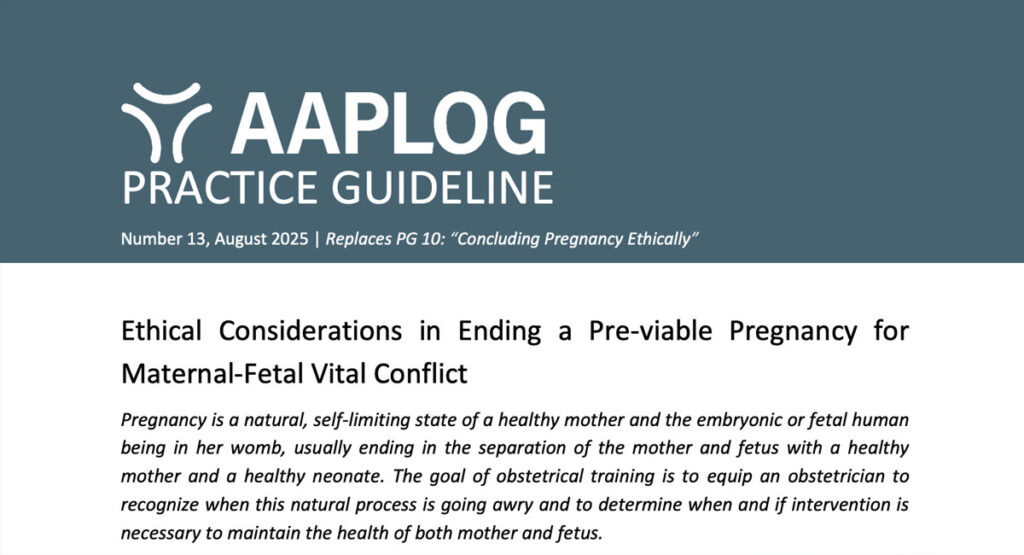
Life-affirming physicians, like you, need support in the Hippocratic practice of medicine as our culture and our profession continues to be bombarded by the abortion industry. That’s why AAPLOG proudly offers and consistently updates our Medical Glossary of Terms and medical position statements. Today, we want to highlight our Practice Guideline on maternal-fetal separation in the event of maternal vital health concerns. This was written in August 2025 and replaces the previous PG 10, Concluding Pregnancy Ethically.
The pro-abortion movement claims the answer to life-threatening pregnancy conditions is induced abortion. That’s why the argument that we often meet online, in the media, the statehouses, and in person is “women need induced abortion because they will die without it.” It’s the wrong answer, obviously, but it is a common misconception. The truth is ethical and more nuanced.
Our practice guideline first defines the term “induced abortion” (a definition consistent with that of the Centers for Disease Control and Prevention’s [CDC]:
“1. The use of any drug, device, surgery, or any procedure or intervention to ensure the death of the living human being in utero before, during, or in the process of separating the mother and her embryo or fetus. 2. Any pre-viable separation of the mother and the living embryo or fetus in utero without proportional danger of maternal death or permanent irreversible damage to one or more of her major body systems.”
Procedures NOT constituting an induced abortion include removing an embryo/fetus that has died of natural causes and/or the removal of placental tissue/remaining parts of the preborn child after an incomplete induced abortion. Another example is the separation of mother and embryo or viable/pre-viable fetus in cases of threat to the life of the mother (ectopic pregnancy, sepsis, and other critical maternal illness before viability) which cannot be managed in any other way.
With these important distinctions in mind, the practice guideline outlines a virtue ethics decision-making framework called the Principle of Double Effect. Used by ethicists of all stripes for over 1,000 years, this principle has four essential elements:
- The action must be morally good or neutral. It can’t be intrinsically evil.
- The one who commits the action must do so to produce the good effect, not the bad effect. If the actor can avoid the bad effect, they should.
- The good effect is not a result of the bad effect.
- The good effect has to be proportionate to the bad effect, with no better alternatives.
The guideline then uses several real-life examples to show how to apply the Principle of Double Effect in situations of mortal risk to pregnant mothers of pre-viable babies. Finally, the document examines the ethics of different separation methods. Acknowledging that these are often very difficult decisions – both for the patient and for ethical physicians – we examine how life-affirming physicians might think through each option and recognize that different physicians and patients might come to different decisions.
We developed this practice guideline in response to consistent questions from members of how best to think through these difficult situations in a way that not only respects the autonomy and dignity of our patients but also your conscience. This document was the result of extensive literature review and discussions with multiple medical bioethicists of a variety of backgrounds as well as consultation with maternal fetal medicine experts. We encourage you to read the document in its entirety. Please see the Resources tab on our public and members website to see all our Practice Guidelines as well as Committee Opinions and other valuable resources and reach out to our team with any questions!