
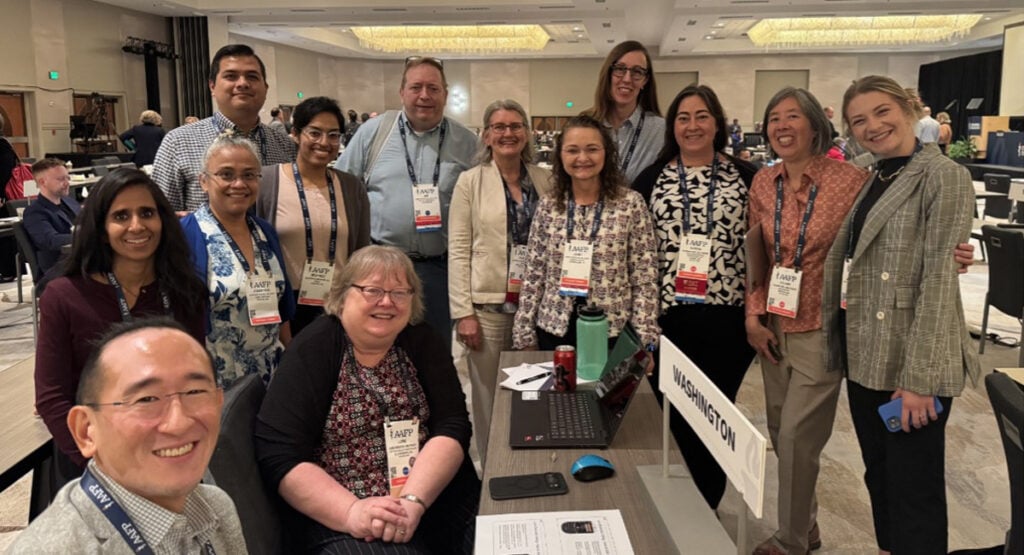
Above: Dr. Glaser (second from left) with family physicians from Louisiana, Missouri, and Texas—members of Physicians for Life—caucusing with AAFP 2025 Delegates from Washington, Vermont, Resident and New Physician constituencies, and the Reproductive Health Member Interest Group.
By Josephine Lee Aguhob Glaser, MD, FAAFP (AAPLOG Lifetime Member)
At this year’s American Academy of Family Physicians (AAFP) Congress of Delegates, I’m thankful to have been part of a historic compromise on a resolution concerning family medicine residency training. Instead of the typical adversarial approach, this year demonstrated that with goodwill and dedication, opposing sides can find common ground to move the AAFP and our profession forward.
Resolution Washington B sparked intense conversation by proposing mandatory, opt-out abortion training for residents. In the spirit of deliberative democracy, both supporters and opponents came forward to voice their concerns. Eighty people on each side submitted online testimony. Two reference committee meetings were held, demonstrating the deep divisions surrounding abortion training in residency.
Yet, what could have been a polarizing battle became an opportunity for cooperation. Representatives from five delegations (Washington, Vermont, Louisiana, Residents, and Member constituency) and two Member Interest Groups (MIGs) —including the Reproductive Health MIG (est. October 2014) and the Physicians for Life MIG (est. April 2020)—came together to find a solution.
The resulting compromise showcases a balanced approach that serves residents, patients, and the entire AAFP. The compromise language retained the resident author’s desire for compiled resources on the AAFP website, while eliminating the ACGME mandate and the opt-out abortion training request. By focusing on resources rather than mandates, the compromise affirms the values of family physicians while ensuring a well-informed AAFP.
This outcome is a testament to the power of dialogue. Instead of talking at each other, the delegates and MIG representatives modeled effective communication, ultimately strengthening the AAFP’s and family physicians’ commitment to compassionate, comprehensive and evidence-based care throughout the human life cycle. It is a hopeful example of how to build bridges on even the most sensitive topics.
I welcome all family medicine students, residents, and physician members of AAPLOG to join the AAFP Physicians for Life Member Interest Group as we continue to advocate for life from fertilization through natural death from within the AAFP.