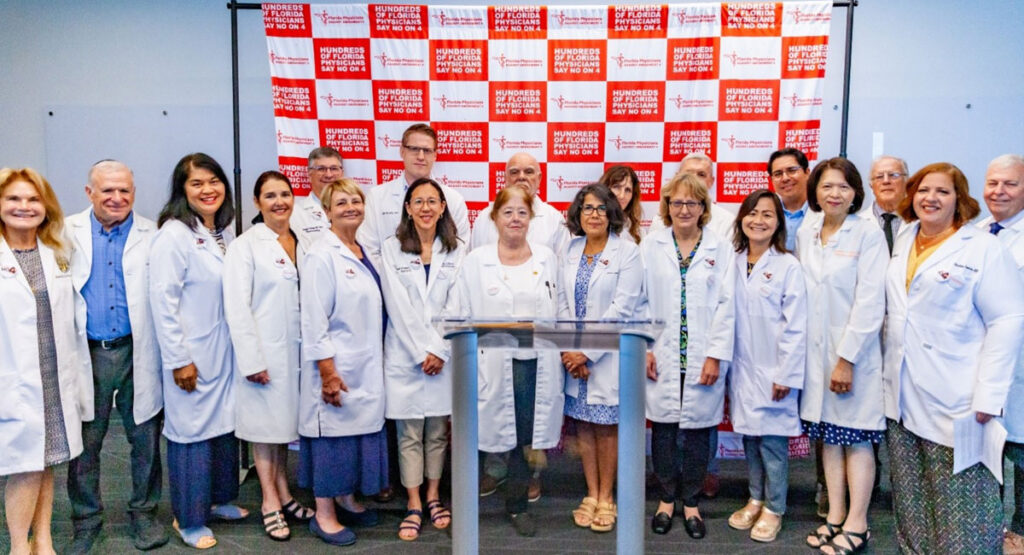
Above: Florida physicians stand united for their patients at the FPAA4 press conference
Ahead of this year’s November 5 elections, we wanted to highlight the advocacy work of our members in several states who are fighting against radical pro-abortion proposed constitutional amendments, supported by our advocacy arm, AAPLOG Action (a 501c4).
In Florida, AAPLOG members and allies are leading Florida Physicians Against Amendment 4 (FPAA4), a coalition of hundreds of physicians committed to opposing their state’s pro-abortion ballot measure, Amendment 4. On September 11, FPAA4 held a press conference (which you can watch here) at which 19 of these physicians were present to show their opposition to Amendment 4. Remarks were made by four Florida physicians, as well as Jason Weida, the Secretary of Florida’s Agency for Healthcare Administration, two post-abortive women, and AAPLOG CEO Dr. Christina Francis. Florida pediatrician and FPAA4 co-chair Dr. Richard Sandler opened the press conference by summarizing the coalition’s points against the amendment, stating, “Amendment 4 is bad medicine for women; it’s bad for children; it’s bad for families.”
The proposed amendment states the following:
No law shall prohibit, penalize, delay, or restrict abortion before viability or when necessary to protect the patient’s health, as determined by the patient’s healthcare provider. This amendment does not change the Legislature’s constitutional authority to require notification to a parent or guardian before a minor has an abortion.
Following Dr. Sandler, AAPLOG member and internist Dr. Angeli Akey further expanded upon the coalition’s concerns regarding Amendment 4 – including that it eliminates physicians’ involvement in induced abortions; eliminates parental consent for induced abortions for minors; allows for second and third-trimester induced abortions through the “patients’ health” loophole; and would permanently cement unregulated induced abortion into the state’s constitution, making it difficult for Floridians to vote on new legislation regulating the practice.
Dr. Akey argued that, by failing to define the term ’healthcare provider’, the amendment opens the door for any licensed or unlicensed individual to perform induced abortions or determine that a woman “needs” a 2ndor 3rd trimester abortion . She also contended that the amendment’s lack of a definition for the term “viability” or “patient’s health” opens the door for the amendment to allow induced abortion at any point in pregnancy and for any reason.
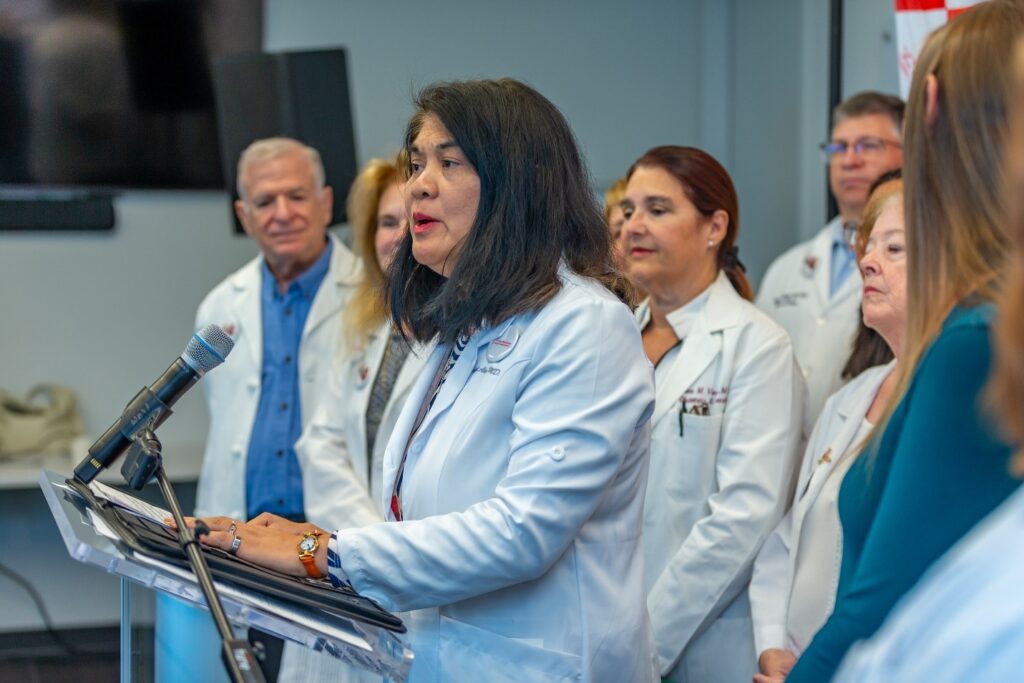
Above: Dr. Angeli Akey offers remarks at the Florida Physicians Against Amendment 4 press conference.
AAPLOG member and board-certified OB-GYN Dr. Tamberly McCarus stated that the amendment is too extreme for the majority of Floridians. She reminded viewers that even pro-choice Floridians should oppose this amendment because of the danger it poses to women and girls.
Dr. Ana Verdeja, another AAPLOG member and board-certified OB/GYN, echoed the sentiments of the previous speakers, adding that the amendment would eliminate 24-hour waiting periods between an initial pregnancy confirmation and counseling appointment and an abortion appointment, which she states is important to allow women to think through this permanent decision.
Special guest Jason Weida, the Florida Agency for Healthcare Administration Secretary, corrected common misinformation surrounding Florida’s current abortion law. “I believe in transparency, and I believe people should understand how healthcare works in their state, and what the laws regarding healthcare actually say,” Weida stated. “Sadly, you see a lot of information out there on this and other issues, especially this issue.”
Weida pointed out that, contrary to common narratives, Florida law clearly allows abortions before there is a detectable heartbeat or if a woman falls under one of the law’s exceptions – including rape, incest, fetal disability, and to preserve the life or major bodily function of the mother. He also notes that the law provides framework for accountability and offering guidance and clarity to women and physicians as needed.
Two women, Christina B. and Barbara C., shared their stories of obtaining abortions as young women, which caused them long-lasting emotional trauma and physical health issues.
Lastly, AAPLOG CEO Dr. Christina Francis shared her experience as a practicing obstetric hospitalist in Indiana, which has a similar abortion law to Florida’s, arguing that she is able to provide excellent healthcare under this law, and reiterated that Amendment 4 would make it “nearly impossible” to implement needed regulations and protections on the practice of induced abortion to protect women and their preborn children.
After the press conference, founding member and board-certified radiologist Dr. Grazie Christie offered additional thoughts to AAPLOG staff on FPAA4 and the amendment.
“To me, it’s very apparent that to doctors, the mother and the unborn child are both patients, and it’s that which motivates me to take care of both the mother and the child,” she stated. “With Amendment 4, both of them are in danger.”
Dr. Christie added that the Florida Department of Medicine has offered guidance on what constitutes an abortion, so there should be little confusion as to when physicians can intervene to treat pregnancy complications.
We are extremely proud of our Florida members’ advocacy work. If you are a Florida physician interested in joining FPAA4, you can visit this webpage. AAPLOG’s advocacy branch, AAPLOG Action, is currently supporting physician coalitions in three other states – Colorado, Arizona and South Dakota. You can follow AAPLOG Action’s work by signing up for their mailing list here.