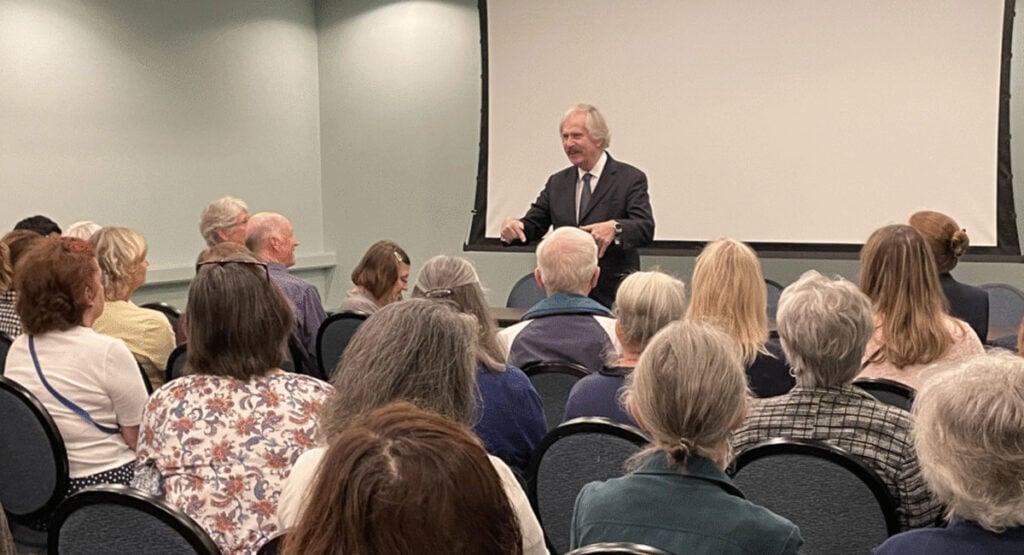
Above: attorney Harold Cassidy offers remarks to supporters and plaintiffs gathered on the day of oral arguments
On July 11, the U.S. District Court for the District of Minnesota heard oral arguments for Women’s Life Care Center et al. v. Walz, Planned Parenthood Minnesota, North Dakota, et al., a case that’s challenging both the abortion giant’s business practices and the Minnesota abortion law. The cases highlights the heartbreaking stories of women who underwent abortions against their will, arguing that Planned Parenthood’s systematic failure to enforce proper informed consent and coercion screening protocols violated these women’s 14th amendment and parental rights.
“No one discussed the real nature of the abortion,” recalls plaintiff Clara Munger, a survivor of forced abortion and one of the 29 women who submitted affidavits for this case, in a press conference statement. “No one asked how I felt about it. No one asked if I really wanted the child. The only thing one woman who met with me did was check to see if I filled out the forms she gave to me. The abortion has haunted me ever since.”
Another one of the plaintiffs in this case is AAPLOG member Dr. David Billings, the medical director of Dakota Hope Clinic, a pregnancy resource center that’s also named as a plaintiff, suing on behalf of itself and the women it serves, many of whom are victims of forced abortions.
Attorney Harold Cassidy, who represents the plaintiffs, told EWTN that “this case is going to expose a national scandal revealing that the majority of pregnant mothers subjected to abortion in this country are subjected to abortions that are the result of coercion, pressure, deception, and in many instances, waivers of fundamental rights that are unknown and uninformed.”
During oral arguments, the defendants urged the court to dismiss the case, arguing that the plaintiffs lacked standing (meaning that they were not qualified to bring this case) and that the state did not harm them.
The suit is asking the court to require the abortion clinic defendants to cease performing abortions until they have mechanisms in place to prevent coerced abortions. It also asks the government to cease implementing Minnesota’s abortion law.
To learn more about this case, visit StopCoercedAbortions.com. To download the lawsuit, click the “download legal complaint” on this webpage.
You can also sign a petition in support of ending coerced abortions via the same webpage.
Stay tuned for further updates on this groundbreaking case.