Religious institutions and individuals have long played a foundational role in shaping medical care both in the United States and around the world. From hospitals to mission work, their influence has been deeply woven into the practice of medicine itself.
But as abortion ideology increasingly gained ground within medical institutions over the last few decades, deeply religious healthcare professionals and organizations have found themselves under growing pressure. This is not happening in isolation. Across the globe, religious persecution, including against Christians, is well documented. It is therefore unsurprising that this discrimination is now extending into the medical space, where conscience and faith often directly inform how we care for our patients.
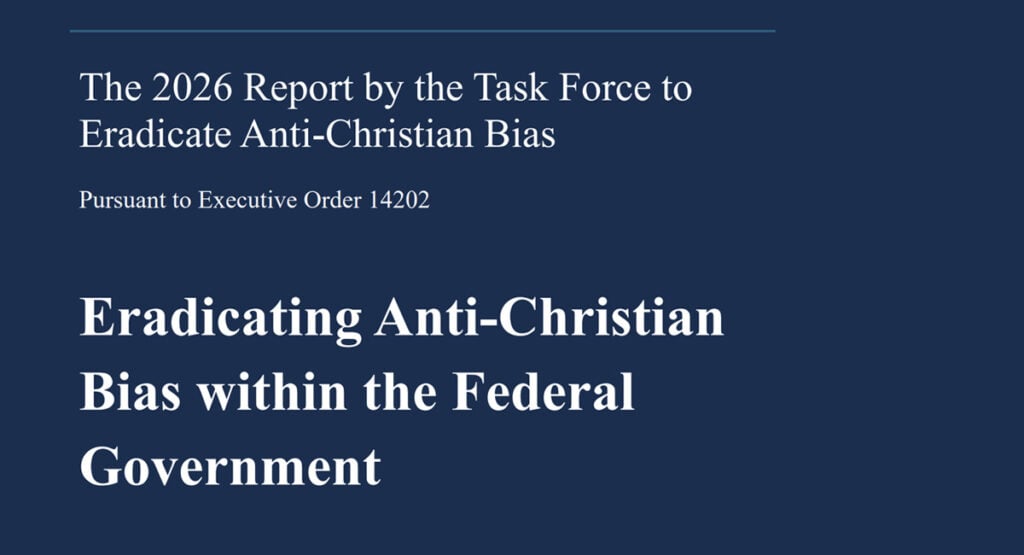
In April 2026, the Trump administration released a report titled “Eradicating Anti-Christian Bias within the Federal Government.” The report examines actions taken during the previous administration and outlines what it describes as discriminatory treatment of Christians across multiple federal agencies.
The report identifies 14 key findings, including concerns about uneven enforcement of federal law, government surveillance of religious groups, and the erosion of conscience protections. Among them:
- The Department of Justice (DOJ) pursued aggressive prosecutions against nonviolent pro-life demonstrators under the FACE Act, while responding less forcefully to attacks on pregnancy resource centers.
- The FBI monitored and investigated certain traditional Catholic groups despite no evidence of criminal activity.
- The IRS investigated churches and Christian organizations based on their religious teachings.
- The Department of Education disproportionately targeted Christian universities with significant penalties.
- The Department of Health and Human Services (HHS) and DOJ scaled back enforcement of conscience protections, including withdrawing action in cases where healthcare workers were allegedly coerced into participating in procedures that violated their beliefs.
- Federal agencies attempted to advance policies related to sexual orientation and gender ideology with limited religious exemptions.
- Christian families and organizations faced barriers to living out their beliefs, particularly in areas related to foster care, healthcare, and education.
- Religious individuals and organizations were denied equal access to certain government programs and protections.
- Religious accommodation processes at times appeared to penalize, rather than protect, those seeking to exercise their rights.
- Federal actions were taken that restricted or limited religious expression and speech in certain contexts.
While each of these findings raises serious concerns, two stand out as particularly relevant for healthcare professionals: the treatment of conscience rights, especially regarding abortion, and the regulation of religious and pro-life expression.
The report includes examples that illustrate these concerns. In one instance, groups of Christian pro-life students and families visiting Washington, D.C., for the 2023 March for Life were reportedly asked by federally managed museums to remove pro-life and religious attire or leave.
In another, HHS issued guidance interpreting the Emergency Medical Treatment and Labor Act (EMTALA) in a way that asserted obligations for abortion provision, regardless of state law, without clearly addressing conscience protections for individual clinicians. Additionally, the Equal Employment Opportunity Commission interpreted the Pregnant Workers Fairness Act in a manner that could require employers to accommodate employee requests for abortion, even in cases where doing so conflicts with the employer’s religious convictions.
AAPLOG has always recognized that conscience rights are essential for physicians to practice ethical, patient-centered medicine that upholds the oath we took and the purpose of our profession. Through AAPLOG Action, we actively advocate on Capitol Hill and in individual states to ensure that medical professionals and students are free to follow their convictions to practice medicine with purpose and towards the health, healing and wholeness of our patients.
A critical first step in protecting these rights is acknowledging the problem—and documenting it clearly. This report reflects concerns that many religious and pro-life Americans have raised for years.
AAPLOG and AAPLOG Action remain committed to defending conscience rights, protecting the integrity of the medical profession, and ensuring that medical professionals are free to practice medicine in accordance with both science and deeply held ethical convictions.